


Source: Talking about Li and other things
Although ETH's price has been rising recently, if you have only entered the market in the past year or so, looking back at the overall situation of your holdings in the past year, you will find that in many cases the ETH you hold can be compared with stablecoins, especially when you see some other coins rising all the way and breaking new highs, while the value of ETH's position is like "stagnant water" without any movement.
When it comes to investing, there seem to be two extremes: one is giving up too early, and the other is being unwilling to give up.
A few days ago, I happened to see a friend leave a message complaining that he invested all 20,000 US dollars to buy ETH last year. As a result, a year has passed, and although ETH has risen again, the amount in his account is still at 20,000 US dollars, which is equivalent to a year of wasted time. It would have been much better if he had bought BTC directly at the beginning.
In fact, as far as this guy’s investment philosophy is concerned, I think there is nothing wrong with it, because he bought the king of altcoins, ETH, rather than various junk projects or on-chain dogs. But this does not seem to change the fact that buying ETH is a relatively bad investment experience this guy has had in more than a year.
Although ETH has experienced 4 waves of increases from last year to now, as shown in the figure below, that is to say, in the past year, this friend theoretically had at least 3 opportunities to withdraw funds from ETH and invest in other projects with greater prospects.
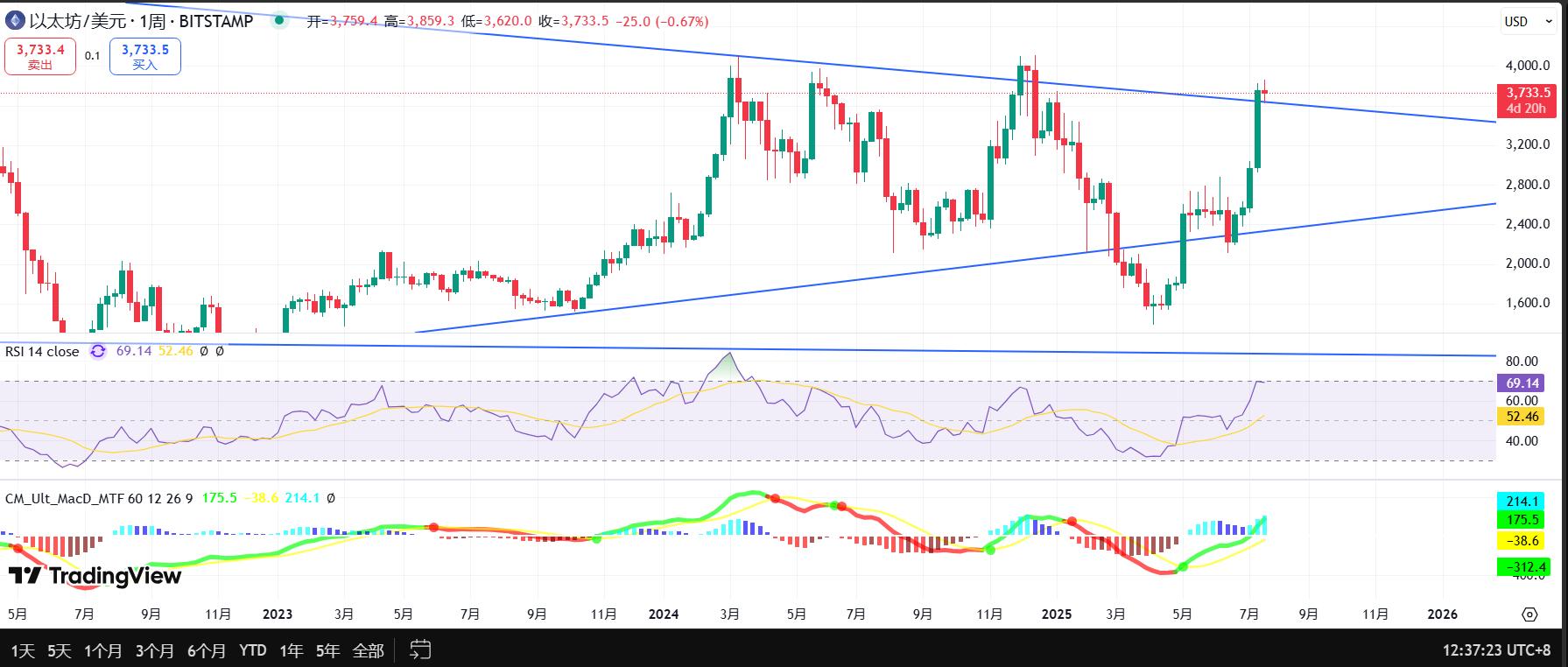
But why didn't he do that?
I think psychologically this boils down to maybe a Sunk Cost Fallacy or Cognitive Dissonance.
The sunk cost fallacy refers to the fact that when people have invested time, money or energy in something, they are often more reluctant to give up, and they will have a mentality of "I have already paid so much, why should I give up now?" Cognitive dissonance refers to the fact that when a person's inner thoughts conflict with actual behavior, in order to reduce discomfort, they often stubbornly maintain a certain behavior or concept, such as knowing that the investment is a failure, but being unwilling to admit the loss in time.
This mentality can be simply summarized in plain words as "unwilling to give up."
Let’s continue with the example of the guy mentioned above. He has been holding on to his ETH even though he had at least 3 opportunities to withdraw it without loss. However, he was “unwilling to give up” and worried about missing out on the market. He would rather watch his money (position value) not actually grow in more than a year than admit he was “wrong” and look for better opportunities.
This is a bit like an office worker who is afraid to give up because he is worried that "what if he loses this job in the future", and has to endure low pay and overtime work, and dares not quit or change jobs.
So, how can we overcome this mentality? From an investment perspective, one of the better solutions is: reasonable goal planning and strict position management.
The simplest idea of so-called reasonable goal planning is to use long-term planning to fight short-term temptations. For example, if your investment goal is for the next five years, and ETH is expected to reach $10,000 in five years, then you don’t need to worry too much about being stuck at $3,800 in the short term.
If you don’t want to bet 100% on a single goal five years from now, and want to seize other short-term opportunities at the same time, you need to make further plans in position management. For example, according to the suggestions in our earlier articles, you can consider dividing your positions in a 5:3:2 ratio, with 50% of your positions used for long-term fixed investment in ETH (or BTC, which can be your most promising project with a long-term industry development vision), 30% of your positions can be used to try to buy and sell several blue chips you are optimistic about (even a small portion of them can be allocated to betting on local dogs), and the remaining 20% can be used to maintain cash (U) liquidity.
But for many people, some seemingly reasonable strategies seem ineffective or meaningless to them, such as the 5:3:2 position management plan we mentioned above. I remember that we often mentioned it in the 2022 article, but so far, it seems that not many people will really follow this suggestion (of course, I myself have not implemented it. Based on my personal risk preferences and goals, I currently use an 8:1:1 position plan, which has been shared in detail in previous articles).
A core issue here may also be the issue of "capital size".
For example, some people enter this field with only $1,000. They may hope to make a small investment for a big return, quickly earn excess returns, or even become rich overnight, rather than formulate some bullshit position plan of 5:3:2.
On the contrary, for those who enter this field with $1 million, this should not be a problem. Because of the amount of money these people have, they will definitely know what to do to be relatively safe and reasonable, and they will not directly use $1 million to bet on a copycat (unless the $1 million comes from a windfall).
Therefore, for those who love gambling, there are only two results: one is to become rich overnight, and the other is to go straight to zero. When every gambler first enters the casino, he firmly believes that he can become rich overnight, but more than 99.9% of people end up with zero. This is the naked reality, but many people still choose to turn a blind eye, especially those who have just entered the casino.
Position management is not simply about allocating funds or selecting targets to buy. In trading operations, "buying" is relatively easy. As long as there is a reasonable target plan and execution strategy, it is also easy to buy at a relatively low position. But "selling" seems to be a difficult problem faced by many people. I often see people complaining: I sold too early and I regret it. I sold too late and I regret it.
For example, imagine:
After Zhang San bought a token, the token rose by 50%, so Zhang San sold the token because he thought that if he didn't sell it, the profit might be lost. But after Zhang San sold it, the token continued to rise by 500%, so Zhang San, who held 50% of the profit, fell into deep regret and blamed himself for selling it too early.
Li Si saw that the token had a good increase, so he bought it and quickly got a 200% floating profit. However, Li Si thought that if he continued to hold the token, he could get 10 times, 20 times or even more profit. He thought that the opportunity to change himself had finally come, and the 200% profit could no longer satisfy him. As a result, he watched the token fall rapidly from a high position, and his hope of getting rich was still lingering in his mind, and he lost half of his principal. So Li Si also fell into deep regret, blaming himself for selling too late. He was unwilling to sell at a loss, and if he didn't sell, he could only stare and envy at the soaring prices of other tokens.
Zhang San and Li Si above may be the epitome of many people, and the main reason for these results may be the mentality of "unwilling to give up" mentioned above.
The market is difficult to predict, and I don’t want to do anything thankless anymore. So for the current issues of buying and selling, we will not give specific targets. That is, we will not tell you which coin to buy now to make a fortune, nor will we tell you at what price you should sell the corresponding coin.
The most we can do is to share in some articles and tell you what we are optimistic about now, what we bought, and how much we sold at what position. At the same time, we will also give some suggestions based on the methodology, such as what we have mentioned in previous articles: For long-term trading plans, it is recommended to operate in batches. The simplest strategy is to insist on buying in the bear market and wait until the bull market to sell; or, you can also consider combining the weekly (K-line) indicators to do the right operation, such as operating according to the two indicators EMA21 and EMA55 (when EMA21 crosses EMA55 from below, it can be regarded as a bullish signal, and when the Bitcoin price touches above EMA21, it is a good stage entry point). For medium- and short-term strategies, it is recommended to directly combine the fundamentals of the project, K-line, or market sentiment, capital flow, etc. to buy + sell in batches, and at the same time, make a good stop-profit/stop-loss plan to control your greed (that is, formulate strict trading discipline).
There is no upper limit to making money. There will always be endless money and new opportunities in the market. However, there is an upper limit to losing money. The size of your capital is your upper limit, that is, the principal is your ticket to participate in the market. A major loss may make you lose the opportunity to return to the market forever.
Just like we also believe that in this round of bull market, Bitcoin may still reach $130,000, $150,000 or even higher, but we still decided to sell in batches and stages starting from $100,000 to make necessary profit-taking. We will not regret selling too early, nor will we regret selling too late. We are just strictly executing our own trading discipline and trading plan according to our own risk preferences.
"Save your life first, then make money" is a good investment philosophy. The market will never lack new opportunities, but whether your capital and mentality can wait for that opportunity is the key issue you should think about.
Often, once people fall into the mentality of desperately pursuing perfection in every transaction, they usually lead to a decrease in their overall "good transactions" and may even fall into a revenge transaction. Therefore, we will not pursue the so-called perfect decision (always buying at the lowest point and selling at the highest point), nor will we pursue the absolute return of a single transaction. We pay more attention to the overall position size under risk management.
In short, you should always make clear decisions about your funds and try to be able to attack or defend. Whether you are a brick player or a card player, you don't need to make meaningless comparisons with others, as long as your position can make you feel comfortable most of the time.
Everyone has a different perception of money. The reason why people lose money is not caused by the dealer or whales, but by their own "unwillingness to give up" mentality.
The market is ruthless, but full of opportunities. The market tends to reward those who are disciplined, patient and have long-term strategic thinking, while punishing those who are greedy, emotional and have no strategy. So, which category are you?
That’s all for today. The sources of the pictures/data cited in the text have been added to the Notion notes. The above content is only personal opinion and analysis, and is only for learning records and communication purposes, and does not constitute any investment advice.