
Author: 1912212.eth, Foresight News
In Zhao Benshan’s skit “We Are Not Short of Money”, Xiao Shenyang said: “The most painful thing in life is that you die without spending your money.” In the blockchain world, perhaps the most painful thing in life is that you die without spending your money, and the huge amount of money you have worked hard to earn is forever “forgotten” on the exchange or chain.
Recently, Binance launched the "Emergency Contacts and Heirs" feature in its APP platform update, which has sparked heated discussions in the market. In terms of specific operations, users can add emergency contacts in the "Account Security" settings of the Binance App. The path is: Home - Personal Information - Account Security - Emergency Contacts. When the account is inactive for a long time, Binance will automatically notify the emergency contact, and the emergency contact has the right to apply for inheritance.
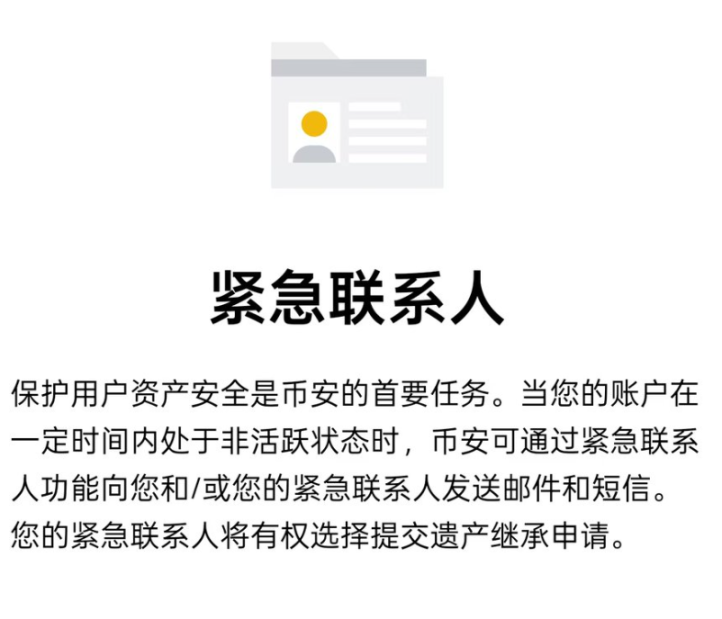
After this feature became widely known, some users took the time to set up emergency contacts.
The Hundred-hundred-dollar Problem of Crypto Asset Inheritance
The decentralized nature of cryptocurrency gives users full control over their assets, but it also brings a thorny problem: when a user dies unexpectedly or loses access to their account, their digital assets are often permanently locked in the blockchain because the private key is lost or unknown. It is estimated that the loss of crypto assets due to accidental death may exceed US$1 billion each year, with a large amount of assets stranded in centralized exchanges.
In April 2018, Matthew Mellon, an early investor in XRP, was a descendant of a prominent American banking family. He invested heavily in XRP in the early days and received huge returns. After his unexpected death, many funds were not taken over by his family or lawyers because the assets were stored in multiple opaque cold wallets and were not properly backed up. At the end of 2018, Gerald Cotten, the founder and CEO of QuadrigaCX, died suddenly in India, claiming that he was the only one who held the private keys to the cold wallets. Since no one can access these wallets, a large amount of user funds have not been recovered to date. The exchange went bankrupt and liquidated, and users suffered heavy losses, becoming one of the most famous "locked positions due to death" cases in the history of encryption. In June 2021, Mircea Popescu, an early Bitcoin evangelist, drowned in Costa Rica. It is rumored that he has tens of thousands of BTC, but he did not leave any clear asset access authorization or inheritance plan, which may result in the permanent loss of his Bitcoin holdings.
One user said, "If a crypto user who has made a fortune quietly encounters an accident, and his relatives and friends have never known about his cryptocurrency trading history, and his parents don't even know what Binance is, then this passive deposit of funds may never be known to anyone."
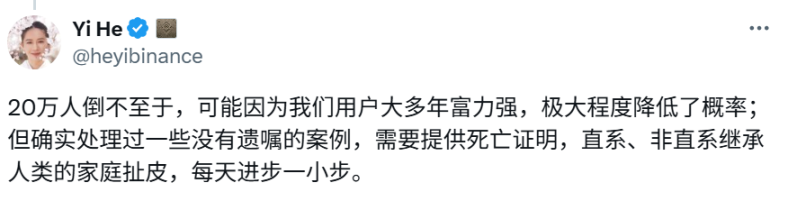
Binance co-founder He Yi publicly responded in the Twitter comment section that Binance users are mostly young and strong, which greatly reduces the probability of accidental death, but they have indeed dealt with some cases without wills, requiring the provision of death certificates and dealing with disputes over direct and indirect inheritance.
In the past, the crypto industry had very limited solutions to this problem. The traditional financial system relies on wills, lawyers, and courts to handle estate distribution, which is a very expensive process. In the crypto world, the anonymity and irreversibility of private keys make this process extremely complicated.
Zhao Changpeng also tweeted and commented: "This is a topic that people don't want to talk about, but humans have not yet achieved immortality. Every platform should have a 'will function' to ensure that when the user is gone, their assets can be distributed to designated accounts in specified proportions." Legal regulatory terms should also allow underage children to have accounts (they may not be allowed to trade, but they can receive payments).
The will function is not new
Entrepreneurs in the crypto space have long considered the issues of asset inheritance and wills, and have promoted the upgrade of wallet functions.
In 2021, the decentralized disable switch application Sarcophagus included the will function. Sarcophagus is built on Ethereum and Arweave. Users can upload files in Sarcophagus and specify the recipient of the private key. If the user fails to perform an action in the future or the set time expires, the recipient will receive the private key and open the file stored by the user in Arweave. Usage scenarios include wills and trusts, password recovery, credential storage, etc.
In 2022, Kirobo, an Israeli blockchain technology developer, launched a crypto asset inheritance feature on its crypto wallet Liquid Vault, allowing users to specify a crypto wallet for inheritance. This feature supports the generation and execution of automated wills without the need for lawyers, government agencies, or any other centralized entities. Users only need to select up to 8 beneficiaries and choose the date to distribute assets to the designated wallet. Later, wallets such as Webacy also launched will-related features.
As for exchanges, Gate launched the "Backup Contact (Account Heir)" feature as early as 5 years ago. After Binance added emergency contacts, it may attract more exchanges and on-chain wallets to follow up and upgrade and optimize this feature.
Digital Heritage Next Stop
Binance's emergency contact and heir features are an important breakthrough in the field of digital asset management, but they are not the end. With the rapid development of the crypto industry, the concept of digital inheritance will become more complex. For example, future solutions may need to cover non-financial assets such as non-fungible tokens (NFTs), decentralized identities (DIDs), and on-chain social relationships. In addition, the combination of smart contracts and multi-signature wallets may further realize automated and trustless asset inheritance.
For users, this feature of Binance reminds us that the management of crypto assets is not only a technical issue, but also a part of life planning. It reminds us that while enjoying the freedom of cryptocurrency, users also need to be prepared for an unpredictable future.
The launch of Binance's emergency contact and heir functions is not only Binance's accurate insight into user needs, but also a move to consolidate its leadership in the global crypto market. In the future, with the further improvement of technology and regulation, the inheritance of digital heritage will become more seamless, and the crypto world will become more humane and sustainable.