

Author: Jaleel Jia Liu, Rhythm
In the 2026 US AI wave, the most profitable investments won't be in well-known companies like Nvidia, Microsoft, Amazon, and Google. While these trillion-dollar giants will certainly see their stock prices rise, even giants struggle to move.
A new wave of stock market gurus specializing in "supply chain attacks" is emerging in droves from Reddit, X, and Substack, leaving the returns of veteran value investors like Buffett far behind. They hold a bunch of micro-cap stocks with market capitalizations ranging from hundreds of millions to billions of dollars, stocks that Wall Street analysts disdain and whose names are practically unpronounceable to ordinary investors.
The person who turned these micro-cap stocks into a trading consensus and trend is Leopold Aschenbrenner, a 22-year-old German who started with $200 million and made $14 billion in stocks, becoming synonymous with the "new stock god".
Following Leopold, the demystification of the Buffett school is accelerating. A new batch of stock market gurus specializing in "supply chain attacks" are emerging in large numbers on Reddit, X, and Substack. They basically ignore financial reports and focus on those micro-cap stocks in the upstream of the supply chain that are "bottlenecked." Following this logic, our editors have compiled a list of some of these new stock market gurus for analysis.
Are all the "new stock market gurus" from Reddit?
Among this new batch of stock market gurus, the most popular and talked-about recently is Serenity, who comes from the WallStreetBets channel on Reddit.
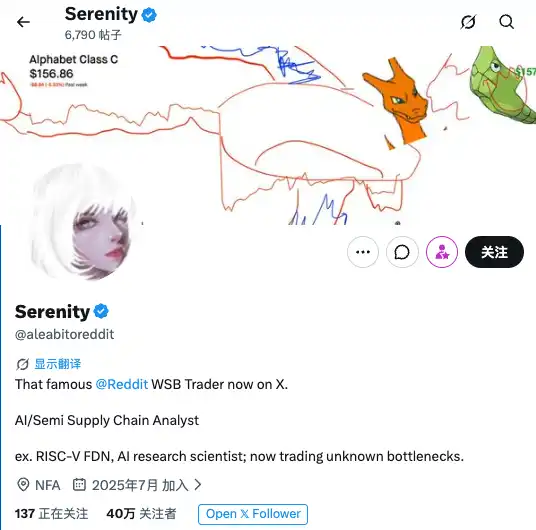
Many readers who trade US stocks are probably familiar with Serenity's story. In short, he was once an AI research scientist, participated in the RISC-V Foundation, published a paper in Nature, and even joked that he rejected an offer from Nvidia's AI team when Nvidia's stock price was $6.
What truly solidified Serenity's "new stock market guru" narrative wasn't his self-described resume, but rather his recommendation of a stock called AXTI on the WSB. His core argument was straightforward: the entire AI industry's development relies on this $700 million market capitalization monopoly, and all players, including Google, Nvidia, and Microsoft, depend on its indium phosphide substrates and materials. He believes the entire AI industry is shifting from Google's TPU to photonics, adopting optical interconnect technology. Without indium phosphide substrates, the entire AI "growth" story will end in 2026.
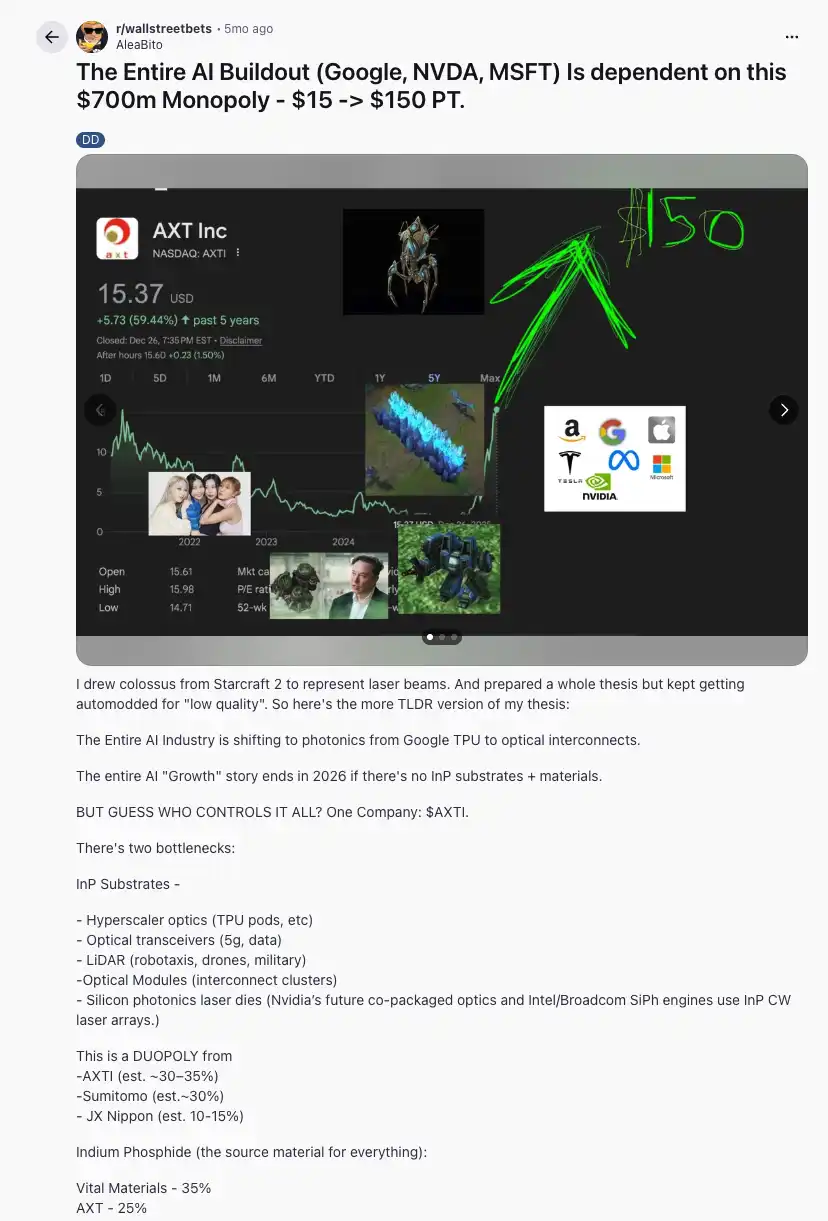
In that AXTI hot post, he directly called out a target price of $15 to $150, and the title was very straightforward.
The stock price provided the best endorsement for Serenity. When Serenity discussed AXTI, the stock price was around $12. After that, AXTI rose steadily, first reaching $70, a trade Serenity himself described as a single-stock profit that once reached 1000%. As of the time of writing, publicly available price charts show AXTI has closed at $140.83, just shy of his initial target price of $150.
This makes Serenity's image more complex and three-dimensional; he is not just a lucky gambler in the WSB, but a deep researcher in the new technology AI industry chain.
Why would someone like this emerge from the WallStreetBets Reddit channel first?
We need to take some time to talk about the history of WallStreetBets.
WallStreetBets, or WSB for short, is the most famous US stock market retail investor community on Reddit. Its appeal isn't because the people there are rational, nor because you can always find the right answers.
On the contrary, WSB first became famous because it brought the two most extreme sides of US retail investors to the forefront: on one hand, short-term options going to zero, all-in bankruptcy, and mutual ridicule; on the other hand, there was the occasional post that could change the market narrative.
The "retail investors vs. Wall Street" battle of 2021 originated from the WSB. A large number of retail investors clashed head-on with short-selling institutions over GameStop, turning a game retail stock initially seen as a relic of the past into global financial news. Since then, the WSB has become more than just a forum. It has transformed into a trading culture: raw, exaggerated, risky, and uncontrolled, but occasionally capable of unearthing valuable insights amidst the noise.
WSB is inherently an ideal place for "non-consensus transactions" to take root. Serenity is a new variant of WSB in the AI bull market.
Previously it was GameStop, AMC, short-term options, and memes; now more and more posts are starting to discuss cloud infrastructure, enterprise automation, AI agents, HBM, optical modules, data center power, photonics, and supply chain bottlenecks.
The WSB's culture of hyping up votes still exists, but what they're hyping up has changed.
This generation of stock market gurus never look at financial statements.
This culture has spread from Reddit to X.
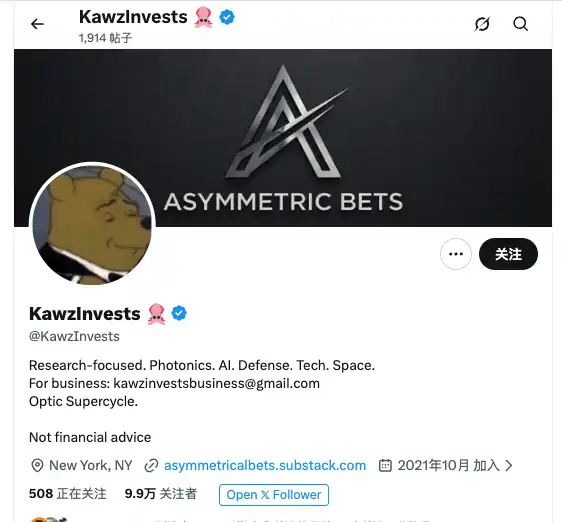
KawzInvests is also a representative of the new generation of stock market gurus, with his account focusing on US stock trading insights and thematic research. Similar to Serenity, his content leans more towards "theme-driven" rather than traditional financial statement analysis.
KawzInvests typically focuses on high-growth sectors such as AI infrastructure, optical communications, defense robotics, biotechnology, automotive software, and small-cap growth stocks, and then looks for underlying logic in areas like supply chain location, order leads, partners, management changes, M&A potential, and valuation revaluation potential.
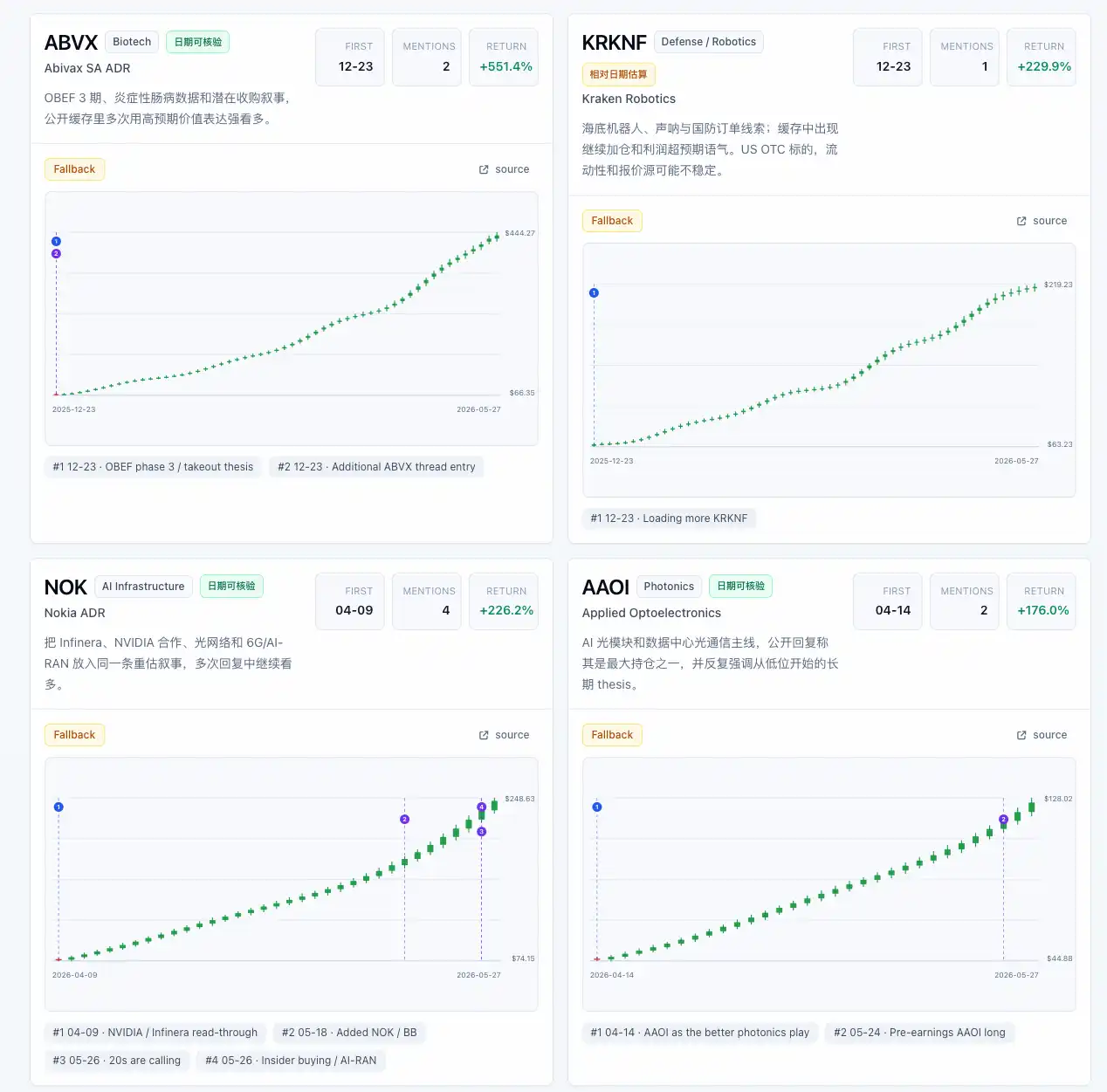
KawzInvests' trading signals
PhotonCap is another typical example.
There are rumors circulating in the market that PhotonCap might be the institutional account behind Serenity, or another shell company for Serenity. This claim has a strong underworld feel and aligns with the common perception of anonymous tech gurus. However, publicly available information doesn't reveal such a relationship. PhotonCap has stated on its Substack that it's a research account run by an optics and photonics engineer who routinely works with lasers, optical fibers, and transceivers, and wanted to study how these components are priced in the stock market. It has also thanked Serenity for the inspiration in its portfolio disclosure.
Going back to where Serenity first started, there are many similar "stock market gurus" on Reddit.
For example, a user with account ID u/imacompnerd.
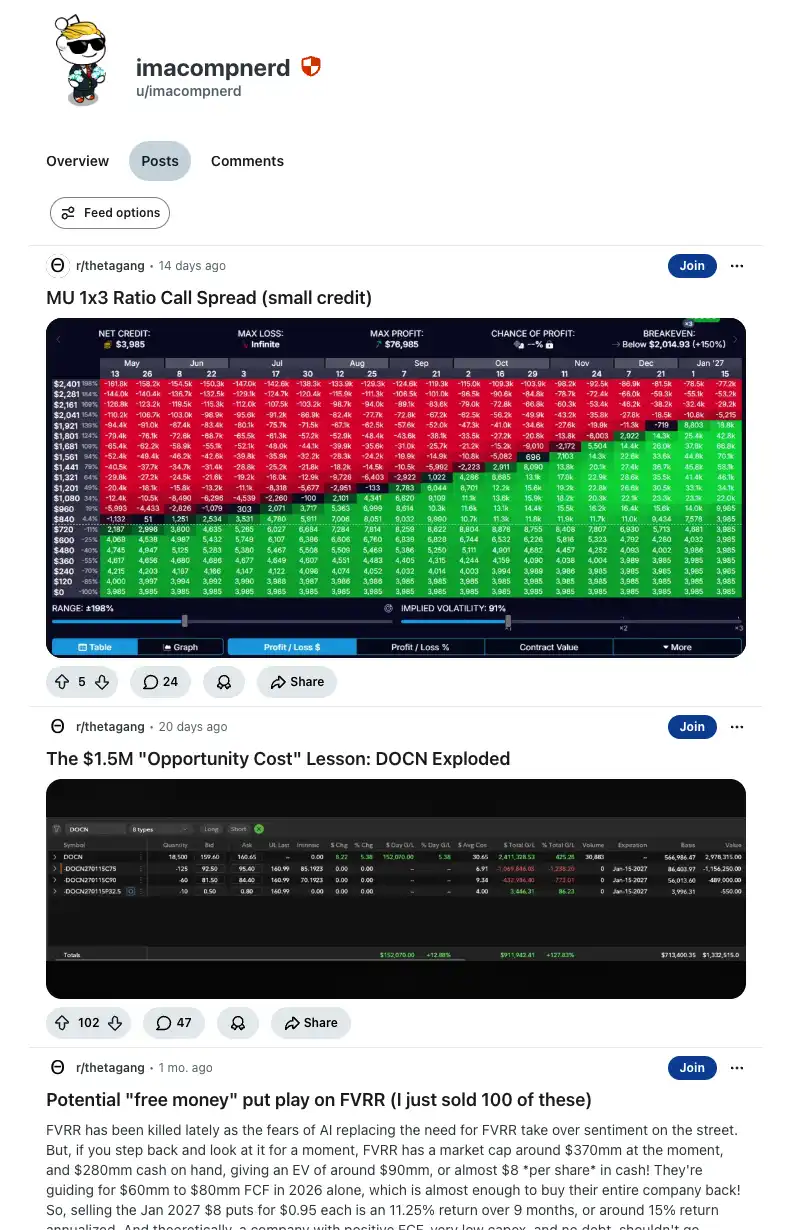
The most talked-about deal by u/imacompnerd is DOCN DigitalOcean. This company is not the most well-known AI leader in the market, but it can be placed in the middle layer narrative of AI deals in 2026: not every developer and SME will directly use AWS, Azure or GCP, and not all AI/ML deployments require the complex systems of giant cloud vendors.
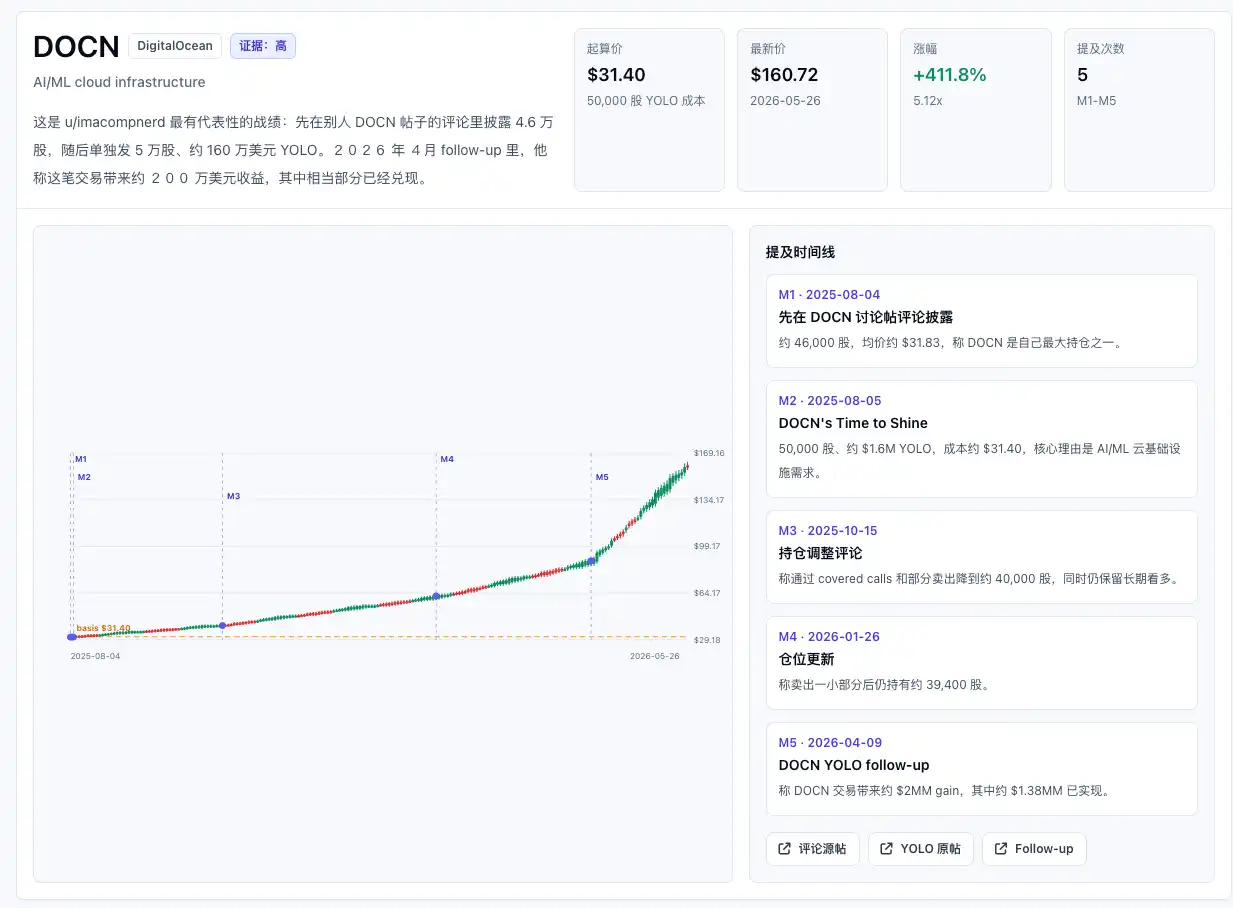
DigitalOcean's story lies in its potential to become a lighter, cheaper, and easier-to-use gateway to AI cloud infrastructure. imacompnerd is betting on this. He publicly disclosed holding 50,000 shares of DOCN, a position worth approximately $1.6 million, at a cost of about $31.40 per share; later, he released a follow-up, stating that the transaction generated approximately $2 million in profit. At current prices, this is no longer just a simple "bullish" move, but a large, concentrated investment with a clear wealth effect.
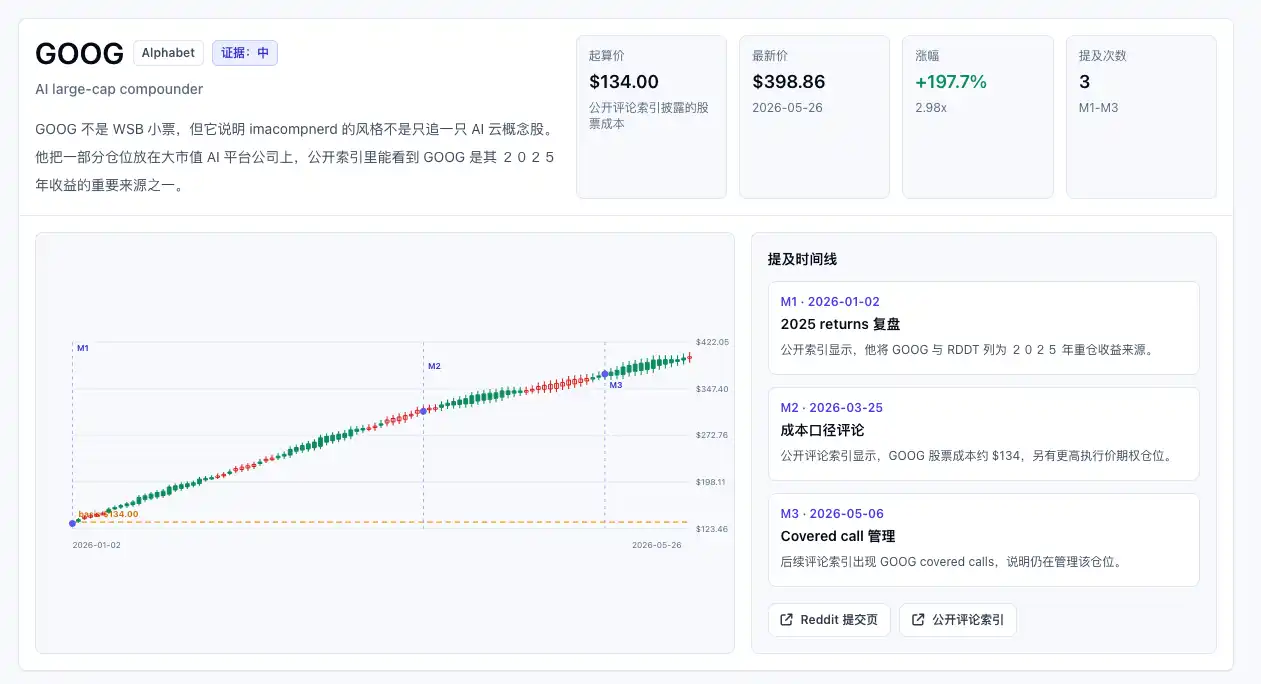
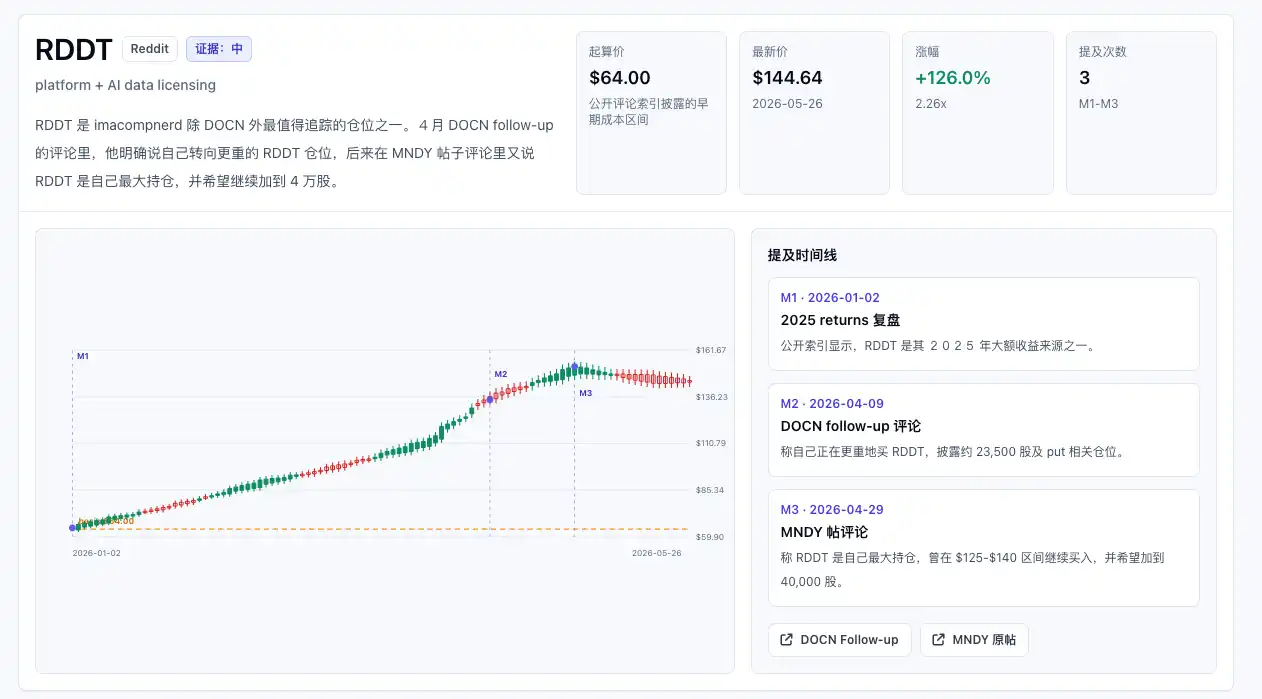
What's even more interesting is that he didn't achieve legendary status solely through a single Reddit investment. Public records also reveal his significant investments in RDDT, GOOG, and MNDY, along with his post-investment analysis. RDDT corresponds to the traffic, community, and AI data licensing potential of the Reddit platform itself; GOOG represents a more traditional large AI platform company; and MNDY represents another revaluation attempt in enterprise software. The MNDY investment is particularly noteworthy because it wasn't a glamorous victory screenshot: he disclosed a position of approximately $1.9 million, but his cost basis was higher than the price at the time of posting, making the short-term outlook less impressive. This makes him more authentic than the average "profit-showing account." His account shows both large wins and unrealized losses; it includes AI cloud infrastructure, platform stocks, and enterprise software; it features concentrated betting as well as position management.
The AI sector in 2026 is seeing fierce competition and intense competition in the market.
US AI stocks saw a half-hour pullback during the session, but funds quickly rushed in to buy on the dip; as soon as memory stocks like Micron and SK Hynix moved, the South Korean market followed suit, and then A-shares in the semiconductor, memory, communication, CPO, and optical module sectors rallied. The market was like a fire, spreading from one AI market to another.
On the other hand, traditional assets are becoming increasingly awkward. Liquor, real estate, insurance, pharmaceuticals, and high-dividend stocks used to be things that could be logically explained. Now, they often become a form of psychological torture: they don't rise when AI stocks rise, and they fall along with the market when it falls. In the past, if you bought the wrong sector, you could comfort yourself by waiting for style rotation; now, the more the AI theme rises, the more it feels like it's draining funds from other sectors.
At times like these, what people fear most isn't losing money, but rather being caught in the wrong era. Seeing others continuously profiting from storage, optical modules, CPOs, AI cloud, and small-cap semiconductor stocks, traditional asset holders can hardly help but question their future. Once anxiety takes hold, it will drive funds further into the AI sector.
When the most prominent AI leaders become too expensive, the most aggressive money will continue to flow into more niche sectors, upstream, and less popular supply chains.
This is also the biggest characteristic of this generation of "stock market gods," and the biggest difference between this generation and the previous generation.
Warren Buffett's working method involves reading 500 pages of material daily, feeding on financial statements, 10-K and 10-Q reports. He once held up a thick stack of papers and told a reporter that knowledge accumulates like compound interest. He looks at ROE, free cash flow, debt-to-equity ratio, and whether management honestly admits mistakes in shareholder letters. His targets are companies that have been operating for decades, have complete financial statements, and stable cash flow. After buying in, he is willing to hold them for ten or twenty years.
All the techniques of the value investing school are based on the premise that "financial statements are the soul of a company".
But the new generation of "stock market gurus" like Leopold Aschenbrenner and Serenity basically don't read this. This generation of "stock market gurus" look at: all the details of earnings calls, customer certification cycles, supply chain and production line rhythms, whether upstream materials are monopolized, whether a certain technology route has moved from thesis to mass production, and whether a certain company is regarded by the market as an old-cycle enterprise.
They are also different from traditional sell-side analysts. Sell-side analysts look at DCF, EPS, guidance, and target price. This generation of stock market gurus, however, bypasses financial statements and jumps to the upstream of the industry chain to find the "bottleneck" node, such as a small company with a market value of several hundred million dollars but whose customer list includes NVIDIA and Google, a substrate material monopolized by a certain company, or a certification cycle that has not yet been covered by sell-side analysts.
Ignoring financial reports and focusing on the logic of the industrial and supply chains is the signature move of WallStreetBets' generation of ticket touts.
This group of people comes from the same era and together they form a new faction in the 2026 AI bull market.
A bull market in the attention economy
Low-liquidity assets, early-stage narratives, highly communicable symbols, community diffusion, and a sense of entry that "has not yet been discovered by mainstream funds."
If you put these terms together, you'll find they can describe both meme coins and the hottest microcap stocks on the US stock market today. The difference is that meme coins have always admitted to being attention-grabbing games, while microcap stocks are disguised as "hard technology supply chain research."
But the essence is the same. Small market capitalization, low trading volume, and limited institutional coverage often place them within a seemingly grand industry narrative. A company with a $700 million market cap is portrayed as a bottleneck in the AI era; a cloud vendor with a $3 billion market cap is touted as the AI gateway for SMEs; a little-known substrate manufacturer is presented as an upstream supplier for NVIDIA, Google, and Microsoft. Once the narrative holds true, the price will rise immediately. Whether the fundamentals have truly materialized remains to be seen several quarters later.
The most interesting thing about micro-cap stocks is that they are not a battleground where institutions are naturally better at playing. On the contrary, the smaller the market capitalization and the lower the liquidity, the more Wall Street's advantage can easily become a constraint.
For an asset management firm with assets in the hundreds of billions or even trillions of dollars, when looking at a small company with a market capitalization of three or four hundred million dollars, the first thought isn't "Is this the best opportunity?" but rather "Can I buy in, and can I sell out?" It faces restrictions on holding ratios, liquidity rules, risk committees, disclosure requirements, and transaction impact costs. For retail investors, a small stock with a market capitalization of three hundred million dollars and daily trading volume of tens of millions of dollars might be large enough; for an institution of BlackRock's caliber, it might be an extremely small position. Buying too little is pointless, while buying too much could directly drive up the price or even trigger disclosure. When it's time to sell, the shallow liquidity could cause significant slippage.
So it's not that they can't see it, but rather that they often can't participate. The larger the institutional money, the more powerful they are in large-cap assets; but in micro-cap stocks, size becomes a cage. The pool of micro-cap stocks is too shallow for large ships to enter.
But the attention economy also has its own physical laws.
Therefore, whether this cross-market alpha can be sustained depends on three things.
First, does the information gap still exist? If only a few FinTwit accounts can clearly explain Photonics' supply chain, CT might indeed have had early access to a batch of low-coverage assets. However, once mainstream sell-side firms, ETFs, and quantitative funds begin to cover it, the narrative premium will be quickly flattened.
Second, can the fundamentals keep up with the attention? AI optical communication is not just empty rhetoric, but the biggest problems with small-cap companies are uncertain orders, concentrated customers, dilution from financing, and long capacity verification cycles. A company may be on the right track, but it may not be able to realize real economic value.
Third, the speed of dissemination itself can create exit congestion. The rise of low-liquidity assets can easily be interpreted as "the market validating the narrative," but it could also just be a short-term surge in attention. The more it resembles a meme coin, the more wary we should be of a meme coin-style liquidity retreat—the story is still there, but the buying power is gone.
This also suggests a market shift: crypto traders are applying their on-chain-trained narrative intuition to US micro-trading, AI hardware, energy, electricity, and supply chain assets. This may be the most noteworthy change in trading culture to observe in the crypto space this year.
The attention economy attribute of microcap stocks in the US stock market existed long before the emergence of meme coins.
Times create heroes, and times never lack new gods.